
Connect With Your Chakras
Understand Your Energy Without the Woo
You don’t have to be spiritual to find this useful.
You’ve probably heard the word “chakra” in a yoga class, a meditation session, or maybe in a wellness article somewhere. Even if it’s new to you, you’ve likely experienced moments when something just doesn’t feel right - no logical reason why. Those moments are linked to your energy, and chakras are a practical way to map it.
Most of us recognise when something feels off. Psychology explains part of it. Neuroscience explains another. Chakras offer a third perspective, not as a belief system, but as a practical tool to notice patterns in how your body, mind, and emotions interact. You don’t need to believe in them as literal energy centres. Think of them as a map that helps you spot stress points faster and respond more intentionally.
Chakras are often called energy centres, but you don’t need to take that literally. Think of them as areas of human experience, each showing how your body, mind, and emotions intersect. From feeling safe and secure, to how you connect with others, express yourself, and make decisions, each chakra gives a lens to notice patterns that might otherwise go unseen.
How Your Feelings Relate to Your Chakras
Sometimes it’s easier to notice patterns in your energy by connecting them to common experiences. Here’s a quick guide:
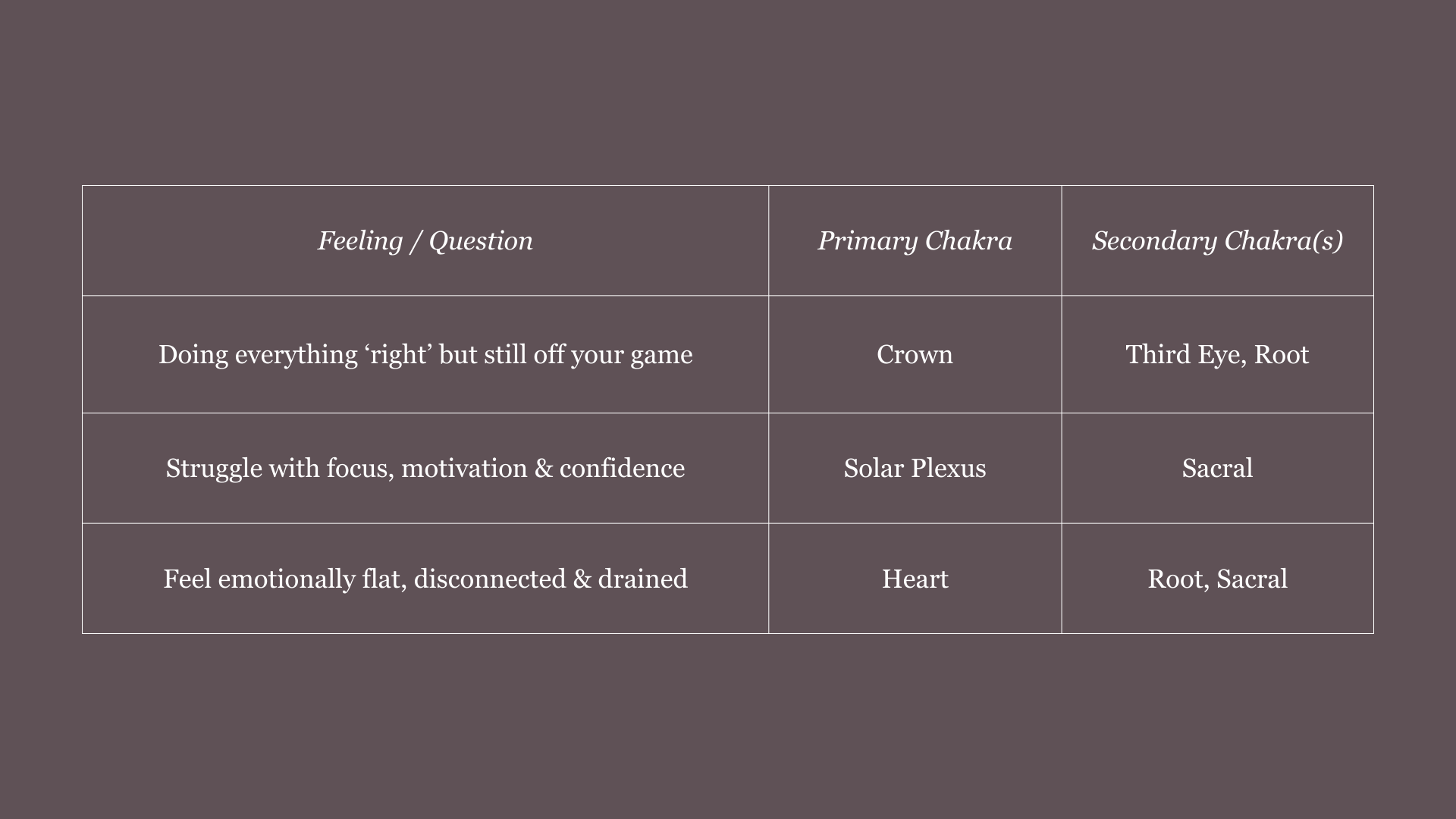
This table isn’t about strict rules - it’s a practical map. If one of these feelings resonates with you, you can look to the corresponding chakra(s) for areas to focus on, notice patterns, and take simple steps to rebalance your energy.
The Seven Primary Chakras: A Simple Map of Your Energy
There are seven main chakras, running from the base of your spine to the top of your head. Each represents a theme that shows up in everyday life - how you feel, how you make decisions, and how you relate to yourself and others.
Root Chakra:
Safety, security, and grounding
How supported you feel physically, financially, and emotionally.
Sacral Chakra:
Emotions, creativity, and relationships
How you experience connection, pleasure, and motivation.
Solar Plexus Chakra:
Confidence, personal power, and decision-making
How you feel about your choices and boundaries.
Heart Chakra:
Compassion, empathy, and connection
How you relate to yourself and the people around you.
Throat Chakra:
Communication and self-expression
How freely you speak and share your ideas.
Third Eye Chakra:
Insight, perspective, and clarity
How clearly you see situations and trust your instincts.
Crown Chakra:
Meaning, purpose, and perspective
How connected you feel to your bigger goals and life vision.
Looking at your energy through this lens helps you spot where things might be out of balance. Maybe your focus dips in the afternoon (solar plexus), or you feel tension in your relationships (heart chakra). The goal isn’t to become perfect at “chakra energy”. It’s to notice patterns, understand yourself better, and take small, practical steps to feel more balanced.
Signs Your Chakras Might Be Out of Balance
Here’s a quick guide to common ways each chakra can show up when it’s out of sync:
Root | Anxiety, insecurity, lower-back tension
Sacral | Mood swings, creative blocks, low motivation
Solar Plexus | Low confidence, indecision, digestive issues
Heart | Emotional withdrawal, difficulty connecting
Throat | Fear of speaking up, feeling unheard
Third Eye | Overthinking, poor sleep, lack of clarity
Crown | Burnout, disconnection, lack of purpose
These are not strict rules - think of them as signposts. They give you clues about where to focus your attention, without any mystical requirement.
A Simple Daily Practice to Tune Into Your Energy
You don’t need a full yoga session or meditation retreat to start. Spend 5–10 minutes a day on this simple routine:
Sit quietly and notice how your body feels.
Observe tension, stress, or patterns without judgement.
Breathe deeply and slowly, connecting with each part of your body.
Visualise light moving from the top of your head down to your feet.
Notice any shifts in energy, mood, or focus.
Doing this consistently helps you spot stress early, understand your patterns, and feel more in control. All without requiring spiritual belief or special magical powers!
